Seven Days Of Festivus '25 - Box Set

You asked for it.... well one person asked for it. Some sort of Advent calendar, we thought that sounds like hard work, she reckoned we could do 12 days of Xmas, we thought that seems more achievable, we put together a list, chopped it down to seven & voila...

Seven x 50g whole beans, enough for 2-3 brews of our favourites from '25. SOLF OUT

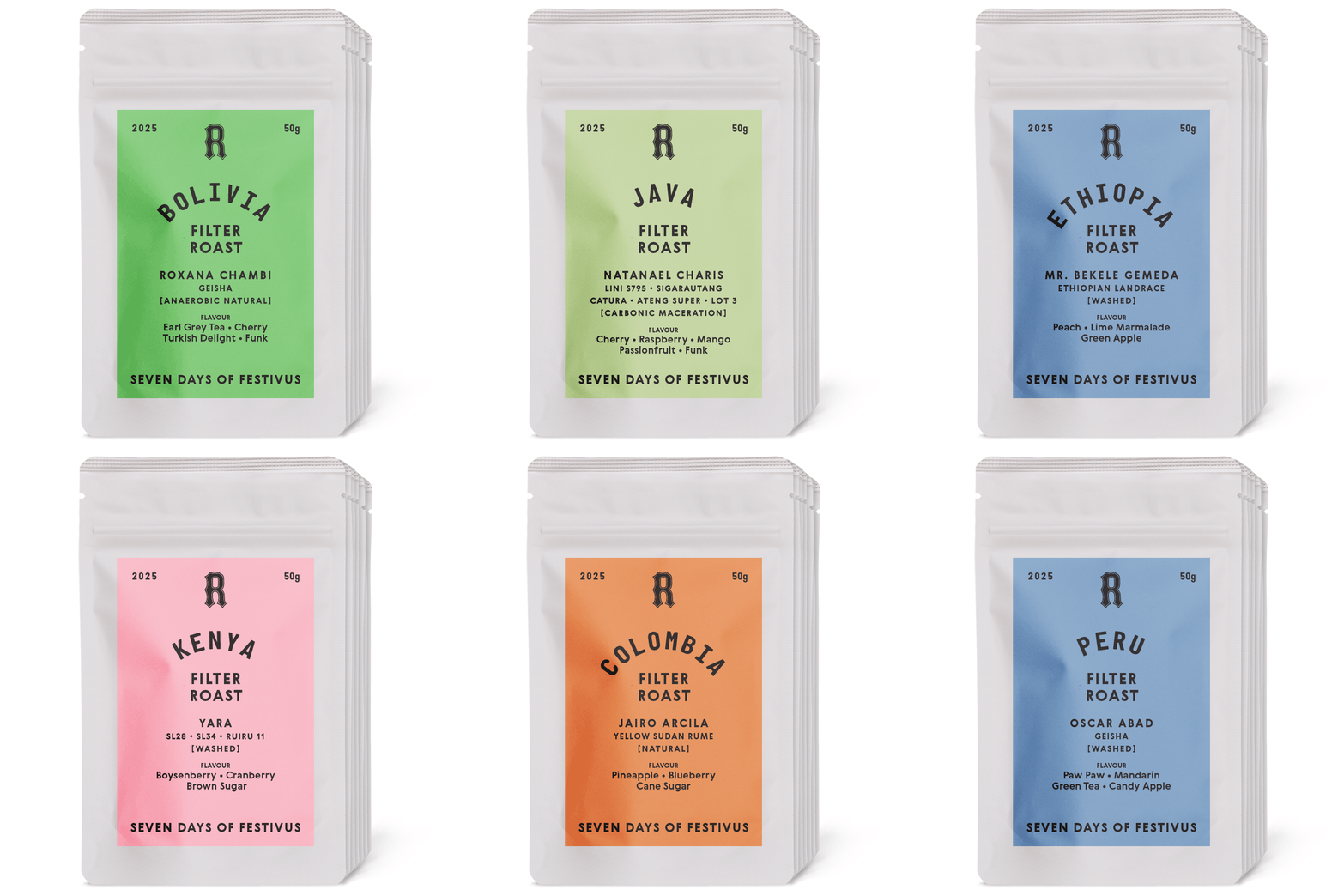
ROXANA CHAMBI - GEISHA [ANAEROBIC NATURAL]
EARL GREY TEA - CHERRY - TURKISH DELIGHT - FUNK

OSCAR ABAD
GEISHA [WASHED]
PAW PAW - MANDARIN - GREEN TEA - CANDY APPLE
JAIRO ARCILA
YELLOW SUDAN RUME [NATURAL]
PINEAPPLE - BLUEBERRY - CANE SUGAR
PAOLA TRUJILLO
WUSH WUSH [WASHED]
BLUEBERRY - APRICOT JAM - ORANGE BLOSSOM
YARA 
SL28 - SL34 - RUIRU 11 [WASHED]
BOYSENBERRY - CRANBERRY - BROWN SUGAR

MR. BEKELE GEMEDA 
ETHIOPIAN LANDRACE [WASHED]
PEACH - LIME MARMALADE - GREEN APPLE

NATANAEL CHARIS
LINI S795 - SIGARARUTANG- CATURA- ATENG SUPER - LOT 3 [CARBONIC MACERATION]
CHERRY - RASPBERRY - MANGO - PASSIONFRUIT - FUNK
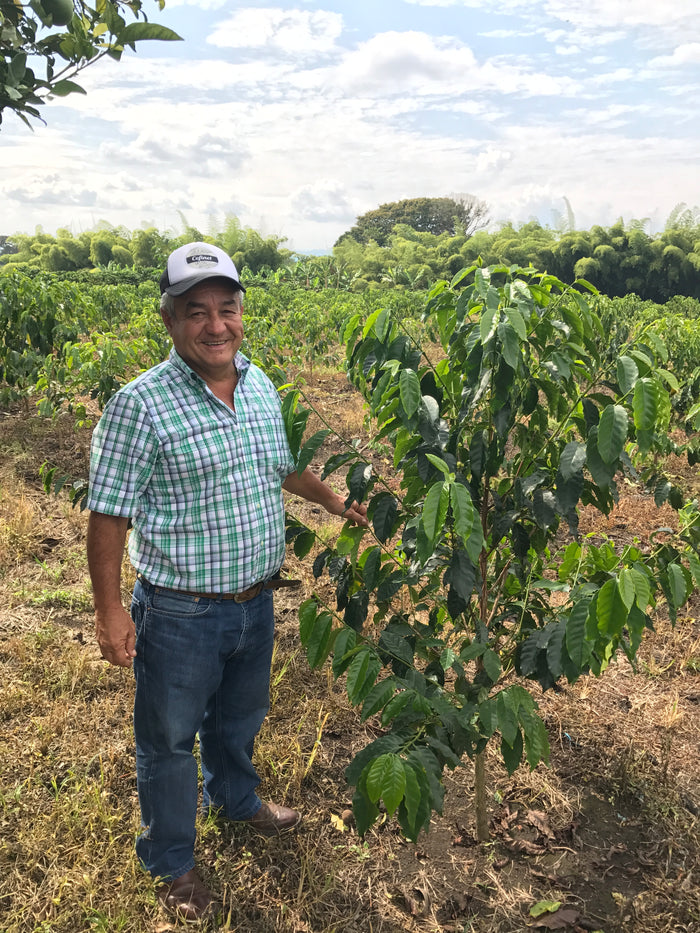
About the farmer(s)

Roxana Chambi - Geisha [anaerobic natural] — Bolivia

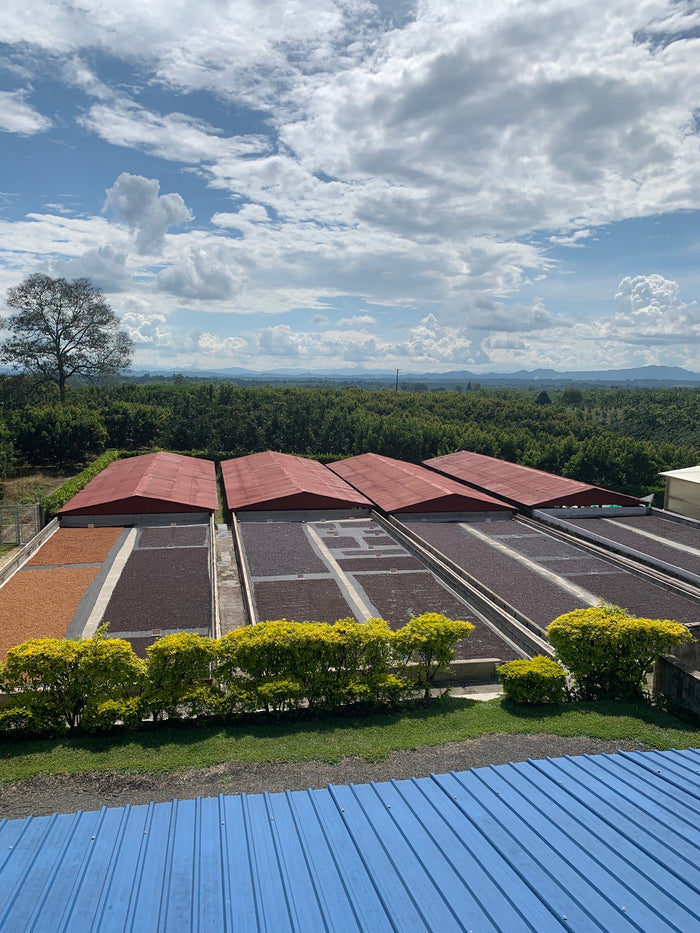
Roxana first planted coffee at her 5-hectare farm San Lorenzo in 2019. The farm is located in Caravani, La Paz, in the Andes Range. This lot was processed using the natural anaerobic method. Once harvested, coffee cherries are washed & sorted, placed in a sealed oxygen free containers to ferment & then spread out to dry on raised beds for 15-20 days. This method produces ripe fruity flavours with increased acidity.

  • region Caravani
  • farm/farmer San Lorenzo
  • altitude 1550 meters
  • crop 2025
  • cultivar Geisha
  • process Anaerobic natural

In 1931, a British ambassador picked a selection of coffee berries in Southwest Ethiopia near a village called Gesha. In 1932 seeds from these plants were sent to Kenya. In 1936 seedlings were sent to Uganda & Tanzania. In the mid 50's seeds were sent from Tanzania to Costa Rica, where trials began. In 1963 Don Pachi Serracin brought some Geisha seeds to Panama, but attempts to grow Geisha were axed due to poor flavour, [most likely caused by the plants growing at too low an altitude]. Geisha, was then forgotten about until 2002 when Daniel Peterson from Hacienda Esmeralda decided to cup coffee from different parts of his farm & came across this extraordinary coffee we know as Geisha.

Oscar Abad - Geisha [washed] — Peru

Oscar owns Finca Picorana. This is a tiny 1-hectare farm, located in San Ignacio, Cajamarca, high in the Andean Mountain Range. Oscar has planted around 5000 coffee trees on the farm & built a small wet-mill to process his coffee. This lot is a washed coffee, during harvest the ripe coffee cherries are picked, taken to the mill where they are washed, sorted to remove defects, de-pulped, dry fermented for 48 hours, washed & then dried on raised beds until the moisture content has reduced to 11%.

  • region Cajamarca
  • farm/farmer Finca Picorana
  • altitude 1700 Meters
  • crop 2024
  • cultivar Geisha
  • process Washed

In 1931, a British ambassador picked a selection of coffee berries in Southwest Ethiopia near a village called Gesha. In 1932 seeds from these plants were sent to Kenya. In 1936 seedlings were sent to Uganda & Tanzania. In the mid 50's seeds were sent from Tanzania to Costa Rica, where trials began. In 1963 Don Pachi Serracin brought some Geisha seeds to Panama, but attempts to grow Geisha were axed due to poor flavour, [most likely caused by the plants growing at too low an altitude]. Geisha, was then forgotten about until 2002 when Daniel Peterson from Hacienda Esmerada decided to cup coffee from different parts of his farm & came across this extraordinary coffee we know as Geisha.

Yara Peaberry - SL28 - SL34 - Ruiiru 11 [washed] — Kenya

Yara Estate is owned by the 1192 member Gatatha Farmers Cooperative Society. The estate was established by a British settler in 1902 as a dairy farm, coffee was planted later in 1930 when a new owner took over. Gatatha FCS was formed by the resident farm workers in 1972 which then purchased the estate. Yara Estate is located on the southern slopes of the Aberdare Range & Mt. Kenya.. The coffee was processed by the washed method. Once harvested, coffee cherries are sorted to remove under/over-ripe cherries, defects & foreign material. They are then de-pulped, dry-fermented, washed, soaked in fresh water & then sun-dried on raised beds. This is a peaberry lot, each cherry having one round bean instead of the more common 2 flat beans.

  • region Kiambu County
  • farm/farmer Yara Estate/ Gatatha FCS
  • altitude 1700 Meters
  • crop 2025
  • cultivar SL28, SL34, Ruiru 11
  • process Washed

SL28 was bred by Scott Laboratories in 1931 using various coffees from Ethiopia, Sudan & Yemen. SL34 is a mutation of French Mission Bourbon selected by Scott Laboratories in the '30s. Ruiru 11 was bred in 1985 at the Coffee Research Station in Ruiru. The aim was for a coffee plant with high resistance to coffee leaf rust & coffee berry disease.

Natanael Charis - Lini S795- Sigararutang - Catura - Ateng Super - lot 3 [carbonic maceration] — Java

This coffee was grown in West Java in rich volcanic soil on the slopes of Mt Papandayan. The mornings are misty & cool, the afternoons warm & sunny. The coffee cherries are tested for ripeness using a refractometer to measure sugar content. When ripe, the cherries are harvested, taken to the washing station, floated in a water tank to select the most dense coffee, then the cherries undergo "thermal shock' held in a drying dome at 65 degrees, after 'thermal shock' the cherries are re-hydrated & selected yeasts are added to kick-start fermentation. The cherries are then pulped & put in carbonic maceration tanks along with red wine yeast, CO2 is added every 3 hours for 36 hours. Once fermentation is complete the coffee is 'wet hulled' & dried at 45 degrees until the moisture reaches 13%. Coffee beans are then gravity sorted to select the most dense coffee & then colour sorted to remove defective beans.

  • region Mt. Papandayan, Java
  • farm/farmer Natcha
  • altitude 1450 meters
  • crop 2025
  • cultivar Lini S595, Sigararutang, Catura, Ateng Super
  • process Carbonic Maceration

S795 was bred by Indian botanists in 1946. It is a cross between S288 [a natural hybrid of Liberica & Arabica] & Kent [an old Typica variety from India]. Sigararutang was discovered by a farmer called Tengku Ibrahim Aman Samsir. He noticed that one coffee plant was different to the others he had planted. It was a small plant, and had only been in the ground for two years, but it already produced lots of cherries. It was noticeably different to his other coffee plants which took three years to flower. Tengku Ibrahim started propagating this one plant, which he thought of as a ‘super varietal’, planting lots of this varietal in the same field. Farmers working around him started noticing the ‘super varietal’ and asked for seeds and plants. Catura, a mutation of Bourbon discovered in Brasil in 1937. The plant is a dwarf so it can be planted close together resulting in more production per hectare. Caturra has good flavour characteristics but is susceptible to disease. Ateng Super is a selection from one dwarf Catimor tree  that produced well. Found in Kecamatan Silih Narah. It's name is short for Aceh Tengah - the regency of Lake Takengon. 

Paola Trujillo - Wush Wush [washed] — Colombia

Paola Trujillo is a young, dedicated coffee grower. She and her family own Patio Bonito, an 11-hectare farm located in Caldono, Cauca. Paola and her family are well-known in the area for growing high-quality coffee. There is a large variety of cultivars grown on the farm, Castillo, V. Colombia, Pink Bourbon, Gesha, Bourbon Aji, Sidra, SL28, Typica, Laurina along with this Wush Wush. Paola studied chemical engineering, & after her studies, she realised she wanted to join the family & support her parents, producing coffee. Paola also provides courses and training at the farm for young people, encouraging their knowledge & passion for coffee.

  • region Caldono, Cauca
  • farm/farmer Patio Bonito
  • altitude 1570-1650 meters
  • crop 2025
  • cultivar Wush Wush
  • process Washed

Wush Wush is a rare coffee arabica cultivar. The seeds originated from wild coffee forests near the town of Wushwush, Southwest Ethiopia. Wush Wush seeds made their way to South & Central America in the mid ‘90’s. The plants have a low yield but can produce sweet, fruity & floral coffee.

Jairo Arcila Yellow Sudan Rume [natural] — Colombia

Jairo Arcila is a third-generation coffee grower from Quindio, Colombia. He is married to Luz Helena Salazar & has two sons, Carlos and Felipe Arcila. Jairo was the Mill Manager at a large Colombian coffee export firm for over 40 years. He purchased his first farm in 1987 & through hard work made enough to purchase Villarazo, where this Sudan Rume was grown. Jairo retired as Mill Manager in 2019 & now works solely on his farms. 

Jairo’s sons are the exporters of this coffee & with their help, Jairo has improved the picking, sorting, and processing of his coffees. His sons have also guided Jairo in the production of exotic varieties. He now produces varieties like Pink Bourbon, Java, Papayo, Gesha & this Yellow Sudan Rume on his farms.

Besides coffee, Jairo also grows mandarin, orange, plantain, and banana at Villarazo. Jairo loves starting the day with a great breakfast & spending time with his family.

This lot was processed using the natural method. The cherries were hand-picked, carefully sorted to remove any defects, dry fermented for 45 hours & then sun-dried on raised beds in temperature-controlled conditions until the moisture content reduced to between 9.5-11%, this takes from 8-12 days.

  • region Quindio
  • farm/farmer Villarazo
  • altitude 1400-1450 meters
  • crop 2025
  • cultivar Yellow Sudan Rume
  • process Natural

Sudan Rume is a rare landrace cultivar that was discovered in the 1940's in the Marsabit Mountains on the Boma Plateau in South Sudan, near the Ethiopian border. Sudan Rume has good disease resistance & was used by Scott Laboratories in the breeding of SL28. It has low productivity, but this is balanced by the wonderful flavour profile.

Mr. Mengeche Derso - Ethiopian Landrace [natural] — Ethiopia

Mengesha Derso produces coffee on his 15-hectare farm in Halu Beriti, Yirga Cheffe in the Ethiopian Highlands. With the help of four of his 12 children, Mengasha tends to the farm, planting, pruning, harvesting & processing. The plants are fertilised with compost & animal manure. The coffee was processed using the natural method, once harvested, the coffee cherries are washed, sorted & then placed on raised beds to dry in the sun. Depending on the weather this can take from 8-25 days.

  • region Haul Beriti
  • farm/farmer Mr. Mengeche Derso
  • altitude 2200-2300 Meters
  • crop 2025
  • cultivar Ethiopian Landrace
  • process Natural

This lot is Ethiopia Landrace. Ethiopia has thousands of indigenous coffee varieties. We've seen figures of between 6-10000. Some of these have names. There are cultivars, [Bourbon, 74110] & hybrid coffees [Ababuna] available. Ethiopian Landrace are coffees that have come from the coffee forests. They are domesticated, locally adapted traditional varieties.